Cummins powers Polish rail revolution
QSK60 and X15 feature in pioneering dual-mode projects with two major OEMs in Poland - PESA and Newag
By Cummins Europe, Global Power Technology Leader
Cummins is playing a pivotal role in two ground-breaking rail projects in Poland which promise to boost efficiency for the service operators while drastically reducing carbon emissions.
The projects involve PESA – Poland’s largest manufacturer of trains – and Newag, a rising force within the European rail industry.
The PESA project is the 111DEa, also known as the Gama DualPower, a four-axle locomotive that combines a 2,800 kW electric motor with a high performance Stage V-compliant Cummins QSK60 diesel pack delivering 2,013 kW of power.
The dual-power capability allows operators to haul heavy freight and passenger trains at speeds of up to 160 kmh under catenary wire, while maintaining a highly respectable 120 kmh on diesel power. The range on a single tank is 920km.
“It’s a two-in-one game-changer,” said Pawel Stolecki, Cummins sales manager for off-highway and rail business.
Huge cost-saving potential
The first unit of the Gama DualPower will enter service in 2027. The initial order from operator PKP Intercity is for 16 locomotives, with 10 more in the pipeline from the same company. Pawel said a number of private operators had also flagged their interest in the model, attracted by the potential of huge cost savings.
The 111DEa will be built at PESA’s headquarters in Bydgoszcz, in the north of Poland, roughly halfway between Poznan and Gdansk.
“Because the locomotive has been developed closely with PKP Intercity to be a perfect fit for Polish domestic operations, the homologation process will be relatively straightforward and certainly a lot faster than if it was intended for multiple European countries,” said Pawel.
“That said, there could well be the potential for it to serve the markets of Czech Republic and Slovakia, where PESA also has a presence, also in Germany where it recently acquired a tram manufacturer.”
Meanwhile, tests are under way on Newag’s Impuls 3 passenger railcar which, like the PESA 111DEa, bridges the gap between electrified and non-electrified regional Polish lines. Roughly 37% of the Polish rail network remains non-electrified.
PKP Intercity has ordered 35 of these vehicles, with the first scheduled to be delivered early in 2027. They will be built in Nowy Sacz.
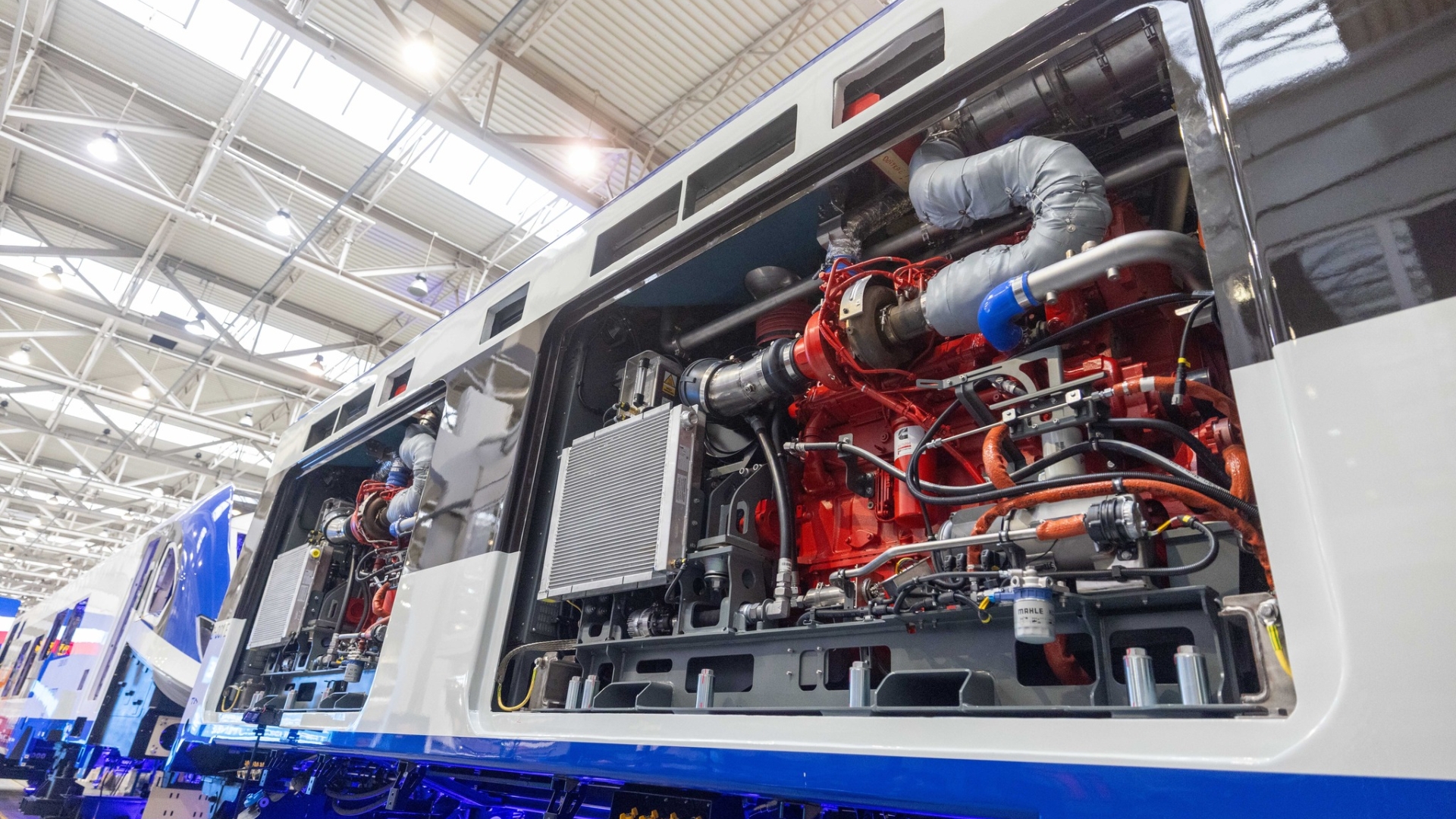
The Impuls 3 features four Cummins X15 diesel engines. This is the first time the X15, which is more commonly associated with the truck and off-highway market, has been integrated in such a way into a passenger train in Europe.
Chosen for its impressive power-to weight ratio and adherence to EU Stage V emissions standards, the X15 allows the Impuls 3 to operate seamlessly on tracks where overhead power is unavailable. Total power output is a shade over two megawatts, and as with the PESA bi-mode, top speeds are 160 kmh (electric) and 120kmh (diesel).
With the quad-engine system, operators can engage all four engines for heavy climbs or rapid acceleration, while tapering down to one or two units for steady-state cruising, optimising fuel consumption.
The installation challenge
On electrified sections, the X15 engines are completely deactivated, saving millions of Euros each year in fuel costs.
“The biggest challenge we faced together as a team was the integration, because fitting engines into locomotives is never easy, and you need to be mindful of the weight distribution,” said Pawel. “Newag has traditionally favoured underfloor installation but that wouldn’t work for the X15s. We settled on having two engines on either side of the dedicated compartment, with the passenger corridor in between.”
Pawel said the Cummins MRC in Krakow was a vital component of the partnerships with PESA and Newag.
“It has definitely boosted the way Cummins is perceived by the rail industry in Poland. Knowing we have the ability to rebuild engines expertly and to factory original standard in the same country is greatly reassuring to our customers and without doubt gives us a competitive advantage.”
Newag looks to NextGen X15 for even more TCO gains
Cummins Poland has confirmed that beyond the initial order for X15 engines (135 in total), for the Impuls 3, Newag will look to adopt the next-generation X15, Powertrain International’s 2026 Alternative Engine of Year.
The NextGen X15 is a product of Cummins’ innovative HELM (Higher Efficiency, Lower Emissions, Multiple Fuels) platform.
By utilising a common base engine design – from the cylinder block down to the crankshaft – the HELM platform allows for specialised cylinder heads and fuel systems tailored to specific energy sources.
The X15 is uniquely suited for integration into hybrid-electric locomotive systems. In these configurations, the engine can function as a prime mover or a high-output generator to maintain battery state-of-charge.
Hybrid operations often require engines to cycle on and off or run at steady-state efficiency. The X15 is optimised for these cycles, offering up to a 10% improvement in fuel economy compared to previous generations, directly reducing total cost of ownership (TCO).
By integrating advanced combustion technology, the NextGen X15 meets the world’s most stringent emissions standards (EPA Tier 4 / EU Stage V) even before the hybrid electric assist is factored in.
Author Profiles
Cummins Europe, Global Power Technology Leader
Cummins Inc. opened its first site in Europe in 1956. Today it has 12 manufacturing sites and more than 10,800 employees in the region. Cummins works hard to provide advanced technologies supported by a long-established service network across Europe. Cummins is committed to investing in Europe through Research and Technology, ensuring Cummins’ technical experts are developing innovations of the future.
Related Tags