Balancing the Equation for Sustainable Mining
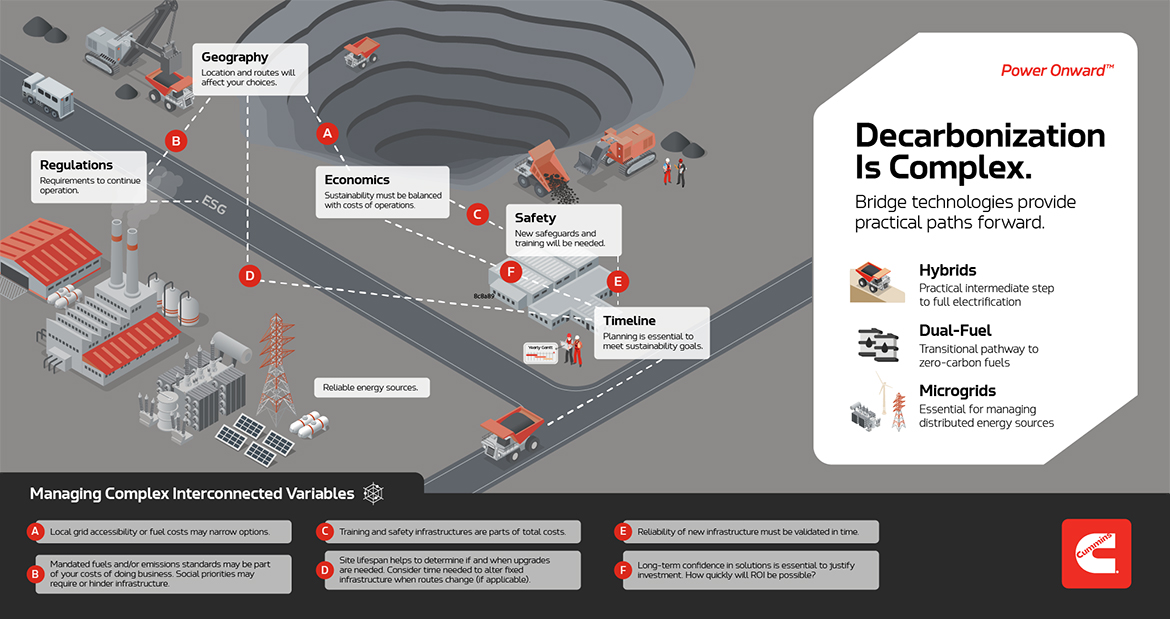
The mining industry continues to make progress on many fronts while facing mounting pressure to accelerate decarbonization in the face of uncertain technology and investment-readiness levels. Unfortunately, a one-size-fits-all solution remains elusive. OEMs are advancing innovations while miners work through the hurdles of adoption. In effect, there’s a “sustainability equation” that must be carefully balanced among technological, operational, commercial and environmental considerations.
Why does mining decarbonization seem so tough? The simple answer is that there are a lot of moving parts. Governments and mining companies alike often underestimate the costs, complexity and feasibility of visionary solutions, such as electrification and clean combustion fuels. Building out the infrastructure to support carbon-friendly solutions takes time and integrating them into existing operations requires careful change management.
The good news is that existing technologies allow us to make significant progress toward carbon neutrality. A global perspective can help you achieve meaningful results now without sacrificing the flexibility to adopt future innovations as they mature.
Variables in the Decarbonization Equation
Mining decarbonization can be thought of as an equation with multiple variables. Assessing these factors will help you determine what’s feasible for your operation to achieve today, and what steps you need to take now to ensure that you’re ready for future needs. The variables in this equation include geographic and economic considerations, regulations, your operation’s timeline and safety protocols associated with alternative technologies.
Geographic Considerations
Location plays a significant role in the selection of any decarbonization technology. Remote sites, for example, may not have ready access to grid power. Even when grid power is available, it may not be sufficiently reliable and can carry higher costs during periods of peak demand. If electrification is your long-term goal, alternative power sources, microgrids and high-voltage equipment are likely to present new challenges to your operation, as well as the long lead times required to become operational.
Your site’s route profiles will influence the most applicable technologies to consider. Does your site have frequent elevation changes or long, flat runs? How often will your routes need to change?
In addition, regional strengths or preferences will likely influence your choices. Do local governments state any fuel requirements (e.g., biodiesel in Indonesia)? Are any alternative fuels or technologies more cost-effective in your mine’s region (e.g., ethanol in Brazil; natural gas in the Middle East)?
Economic Considerations
Miners need to weigh current production costs against alternative solutions that could improve their total costs of operation, while also lowering carbon emissions.
Bringing the grid closer to your site or increasing its capacity to support electrification will involve time and money. You may need to augment grid capacity with renewable energy sources such as solar or wind power. Either way, it’s likely that you’ll need to evaluate the costs of adding high-voltage power distribution and a charging infrastructure.
Similar calculations will be necessary if you’re considering alternative fuels, each of which could come with new infrastructural costs, whether they replace or augment the fuels you’re using now. Cost factors will vary depending on what alternative fuels are available in your site’s region, as well as the carbon intensities and relative costs of the various options.
Alternative energy sources may require equipment upgrades and could also pose new fuel handling and maintenance costs. For example, biodiesel may not be stored or transported in the same tanks, trucks or pipelines as petroleum diesel. It may also require specialized filters or more frequent filter changes.
In addition to physical infrastructure, consider the expertise you’ll need to go with it. Adding hybrid or battery-electric vehicles (BEVs) to your fleet will require training workers with electrical engineering expertise. In most cases, automated operations are considered a precursor to electrifying a fleet for efficiency and human safety.
Ultimately, miners must determine whether a given decarbonization pathway delivers sufficient operational, environmental and economic value. The answer may hinge on any incentives or carbon credits available in your region, as well as opportunities for green premiums.
Regulations
Decarbonization isn’t always a choice. Depending on your mine’s location and other variables, you may have to comply with regional policies or mandates. In addition to current policies, you’ll need to factor in requirements that are scheduled to take effect (as well as how likely those requirements are to be implemented as planned).
Your site may also need to consider any social license to operate — factors that could either support or hinder decarbonization. You might need to route high-voltage power lines or pipelines around nature conservation areas, historic sites or land held by indigenous populations. Some regions also prioritize the needs and wishes of schools, residential neighborhoods or other stakeholders.
Timeline
How do you see your operations evolving between now and 2050? It’s important to factor in how long it will take you to get there, and what you’ll need to have in place.
Ask yourself questions like these:
- What bridge technologies can help future-proof your operation?
- What training will you need to ensure your operators understand new energy sources?
- What safety protocols do you need to build?
If your operations are in remote locations, you’ll need more time to accomplish all these things. Sometimes, the remaining mine life and asset lifecycle will hold the key to which solution is worth pursuing at a given point in time.
Safety
Alternative energy sources will require new or expanded safety protocols. Hydrogen, for example, is highly combustible and can burn with an almost invisible flame. It needs to be stored in well-ventilated areas with specialized flame detectors, and vehicles that utilize it need to be equipped with purpose-built safety systems. Rigorous safety training is also essential for fuels based on ammonia, which is extremely toxic. Storage areas and tanks must be refrigerated, isolated by multiple barriers to prevent exposure, with highly sensitive leak detection sensors and alarms.
Despite growing interest in electrification, most mining operations have no matured safety protocols or policies for high-voltage operations. These will need to be defined for battery-powered electric/hybrid vehicles and charging infrastructure, as well as for operators of such high-voltage electric trucks.
Bridge Technologies Provide a Practical Near-Term Strategy
Cummins is developing technological pathways to bridge the gap between what’s practical and what’s possible by reducing carbon with hybridization and clean fuels. Each pathway includes retrofit solutions that allow miners to maximize the life of existing fleets and equipment. Many can be implemented gradually to minimize their impact, such as during scheduled rebuild cycles.
This approach will allow miners to take meaningful steps to reduce carbon today, while retaining the flexibility to adapt through first-fit applications and modular component upgrades as technologies and infrastructures evolve. Bridge technologies can also reduce transition risk by allowing teams, processes and infrastructure to evolve gradually as new technologies mature.
Three key technologies to consider today include:
- Microgrids — integrating and managing diverse energy sources
- Hybridization — augmenting internal combustion engine (ICE) powertrains with battery power
- Dual-fuel solutions — leveraging cleaner alternative fuels with lower carbon intensity and costs
Microgrids
Microgrids will play an increasingly important role, not only for BEVs, but as mines move toward greater electrification in general. They’re critical for managing distributed energy sources, such as solar, wind, hydropower, battery storage and standby generators.
In particular, microgrids enable the prioritization of power loads, ensuring that essential systems like underground ventilation and elevators have the uninterrupted power required to keep workers safe. They also facilitate peak shaving, a cost-optimization strategy that draws from the grid during low-cost periods and stores energy for use during more expensive peak demand.
The reliability of this infrastructure must be proven over time to ensure that it can prevent catastrophic power outages. Instead of shutting down for months or even years while that happens, it’s best to build it out gradually alongside other electrification efforts.
Hybrid Vehicles
Hybridization is a practical intermediate step toward full electrification that allows operations to build experience with electric technologies. Unlike BEVs, hybrid engines may not require charging stations. They can use a combustion engine as a generator like a traditional vehicle, but with the added advantage of regenerative braking. This makes them especially efficient at mining sites with steep elevation changes.
As a result, you don’t need to install high-voltage infrastructure or have a fully validated microgrid in place to start using hybrids. They allow you to lower your carbon footprint right away, reducing fuel burn while gaining operational familiarity with electric systems at a comfortable pace.
The benefits hybrids deliver aren’t limited to decarbonization. They offer the same level of operational flexibility as conventional diesel vehicles, plus superior power when traveling up inclines to get more work done. The reduced load on the engine could also accrue some engine maintenance savings over time. The combustion engine operates in the same familiar way as conventional engines. It can still run on traditional fuel if the battery gets depleted, enhancing reliability and safety. And unlike trolley-style systems, they don’t require a cumbersome fixed infrastructure.
Adding hybrid equipment and/or gradually retrofitting your existing fleet makes practical sense for more efficient haulage in general or as a stepping stone to full electrification. You’ll get meaningful emissions reductions, plus breathing room to build up electrical expertise and infrastructure as BEV technology matures. In addition, hybrid batteries can potentially be repurposed for energy storage after they reach the end of their rated service life for powering vehicles.
Dual-Fuel Solutions
Dual-fuel engines utilize a combination of diesel and a cleaner alternative fuel. They work by injecting both fuels into the engine simultaneously, automatically optimizing the ratio with an onboard controller. As with hybrids, the diesel capability of the engine can keep you going if your alternative fuel runs out, making your operations more energy resilient.
This technology generally maintains diesel-only performance, no change to operator experience or fueling schedules and no penalty to mine productivity. It’s also attractive in regions that prioritize energy independence or mandate the use of biofuels. In Brazil, for example, an ethanol-diesel combination can positively impact operating costs while reducing reliance on diesel imports — and the high tariff costs that come with them.
Fuel availability and carbon intensity are the key factors that can determine which secondary fuel makes the most sense. Today, adjusting for calorific and volumetric efficiency ranks next best to diesel. Growing demand and global trade for gasoline blending and other industries like aviation and marine could make ethanol the most available and cost-effective alternative fuel for mining applications in many regions beyond Brazil. Natural gas and methanol could also be used with existing technologies where available. Emissions can be further reduced by replacing diesel with hydrotreated vegetable oil (HVO) or biodiesel blends.
Dual-fuel engines may require some logistical adjustments and maintenance adaptations, such as additional fuel tanks and handling. In general, however, these could be less complex than the electrical expertise needed for batteries and high-voltage electronics.
Looking ahead, these systems can provide a pathway toward vehicles powered entirely by a single alternative or potential zero-carbon fuel.
Future-Proofing Mining Operations
Whether your operation is leading the change, responding to regional compliance demands, or taking a more gradual approach, staying flexible is essential.
The path to full decarbonization is still unfolding and will likely remain expensive, but momentum is building as new solutions continue to be piloted. Evolving regulations and emerging technologies are shaping a future where sustainable mining will not only be possible, but increasingly achievable.
Bridge technologies allow learning and infrastructural development to take place without committing to a single solution prematurely. These pathways make it possible to achieve real benefits with technology that’s viable today, while remaining aligned with the visionary goals of tomorrow.
Author Profiles